
Holistic Healing, Spirituality, and Why It Matters

When Evidence Isn’t the Only Evidence: Holistic Healing, Spirituality, and Why It Matters
A few years back, I was invited to facilitate a training. I showed up prepared and calm, ready to share insights on holistic practices for substance use recovery and mental health. What I didn’t know and wasn’t told was who my audience actually was.
That piece of missing information mattered more than I realized.
I went in with ease, thinking I was speaking to an open-minded, maybe even general audience. I began sharing how holistic approaches like mindfulness, acupuncture, and nature-based therapy (ecotherapy) can support mental health and recovery…not as replacements, but as integrative tools that meet people where they are. I also made a point to say something I’ve always believed and practiced:
Many holistic methods, especially the ever-popular mindfulness, include a spiritual component—and that’s important for both clinicians and clients to understand.
What followed was... a lot of heavy tension.
Someone in the room—who may not have even been a therapist—expressed visible frustration. And later, another clinician jumped in to explain, in response to my earlier point, that spirituality can be scientifically proven. The moment threw me off. I didn’t have the words right then. I stuttered. I paused. Because let’s be honest: being put on the spot as a facilitator, in front of peers, is hard enough.
But I’ve had time to reflect. And now, I know what I wish I’d said and why this conversation is so much bigger than a workshop or a disagreement over science.
Why Holistic Approaches Aren’t Always “Evidence-Based”
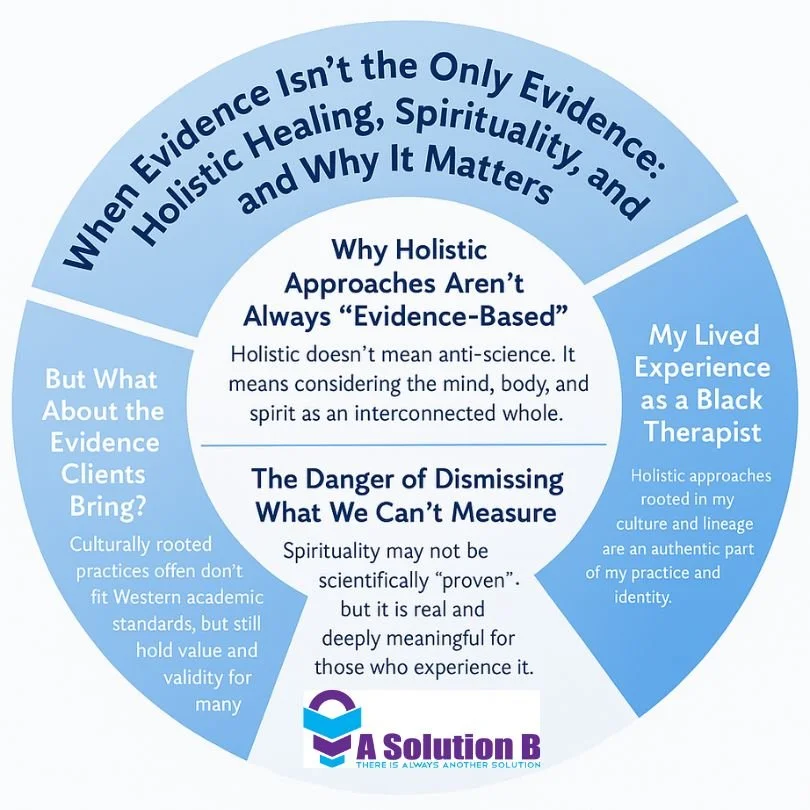
Let’s start with this: holistic doesn’t mean anti-science. It means whole-person. It means looking at the mind, body, and spirit not just as separate parts, but as a deeply connected system.
But here’s the sticking point: when people hear that something “isn’t evidence-based,” they often interpret it as "it doesn’t work." That’s not always true. Sometimes, the issue is that it simply doesn’t pass the gold standard of Western science: the double-blind, randomized controlled trial.
Let’s take spirituality, for example.
Yes, we have studies showing that belief in a higher power or sense of purpose can improve emotional resilience and reduce depression.
Yes, we can even track brain changes during meditation and prayer.
But science hasn’t figured out how the connection works.
Share this!
Share this image if it resonates with you.
We can see effects: lower cortisol, more activity in certain brain regions but we can’t pinpoint a clear, measurable, replicable “mechanism” for faith. So, by academic standards, it doesn’t make the cut as “evidence-based.”
That’s not a flaw in spirituality. That’s a limitation of the system we’re using to study it.
But What About the Evidence Clients Bring?
Here’s where I get fired up.
We cannot talk about holistic healing—and certainly not spirituality—without naming how Western clinical frameworks have historically excluded and invalidated the lived experiences of people of color.
When someone says, “Only use evidence-based practices,” it sounds neutral. But in practice, it often silences culturally rooted healing practices that haven’t been studied under a Western academic lens.
Practices like herbal medicine, spiritual rituals, ancestral healing, or even storytelling as therapy.
Traditions that are passed down, not peer-reviewed.
For many of my clients—especially Black clients and clients of color—that lived, cultural evidence is enough. It’s real. It’s embodied. It works.
And sometimes, that’s more powerful than a randomized control trial.
My Lived Experience as a Black Therapist
This is exactly why, on my About Me page, I say:
“I incorporate your culture…if that’s important to you.”
Because my own culture and lineage are deeply significant to me. I didn’t come into this work through textbooks alone. I came into it through lived experience. Through witnessing how healing happens in community, in rituals, in gardens, in kitchens, and in prayer.
So when I bring holistic approaches into my practice—whether that’s mindfulness, ecotherapy, or exploring spiritual meaning—I’m not doing it because it’s trendy. I’m doing it because it’s true to who I am and because healing is not one-size-fits-all.
The Danger of Dismissing What We Can’t Measure
Back to that day in the training when I was told, essentially, that I was wrong for naming spirituality as something that can’t be “proven.”
Here’s what I know now, and what I wish I had said:
Just because something can’t be scientifically proven doesn’t mean it isn’t valid.
There are many things science hasn’t fully explained: love, grief, the body’s ability to remember trauma. We can study their effects, but we can’t always reduce them to a lab result.
And for me, this goes beyond theory. I grew up in a Pentecostal church, where I witnessed people speaking in tongues, catching the Holy Ghost, and being “slain in the Spirit.” These moments were powerful. Real. Sacred. And there is no MRI, no double-blind study that can explain what I saw and felt in those rooms.
It’s the same with African spiritual practices, ancestral rituals, or shamanic traditions. These ways of connecting to the divine—through drumming, chanting, dreams, and ceremony—are part of centuries-old belief systems. But they don’t fit neatly into Western frameworks. And yet, they’re deeply healing for many.
So when we insist that only “evidence-based” practices are valid, we risk erasing entire cultures and ways of knowing. We silence the sacred.
Bridging the Gap Between Clinical and Cultural
As therapists, educators, and healers, our job is not to choose sides between science and spirit. It’s to hold space for both; to bring the best of what clinical research offers and the wisdom of culture, ancestry, and lived experience.
Holistic healing isn’t about rejecting the clinical. It’s about expanding it.
And yes, insurance companies and institutions require evidence-based practices. That’s a real and valid conversation. But we can meet those requirements while still validating the soul.
Final Thoughts
I didn’t have all the words that day during the training. And maybe that’s okay. Maybe the moment wasn’t about debating science. Maybe it was an invitation for all of us to get curious about what we’re not measuring… and why.
If you’re a therapist, educator, or simply a human navigating healing, I hope you remember this:
Evidence-based is important. But it’s not everything.
Lived experience matters.
Culture matters.
Spirituality, even when unmeasurable, is real to those who feel it.
And as a Black therapist rooted in my own culture and lineage, I’ll always make room for that.
Want to explore holistic healing, grounded in both clinical knowledge and cultural truth?
Let’s talk. You don’t have to choose between science and soul. You get to bring your whole self.
Why This Matters for Women Healers and Entrepreneurs
If you’re a woman in the healing space whether you're a therapist, coach, wellness practitioner, or creative entrepreneur you’ve likely felt the pressure to validate your work with hard data. Especially in professional or clinical circles, it can feel like you're constantly defending the value of your intuition, your culture, or your ancestral knowledge.
But here’s the truth:
Your work doesn’t have to be measurable to be meaningful.
Many of us, especially Black women and women of color are drawing from lineages of healing that pre-date research journals and treatment manuals. And that knowledge, that wisdom, is valid.
So if you’re building a business rooted in care, soul, and story…
If you're blending clinical skill with cultural and spiritual knowing…
If you're creating spaces where healing doesn’t have to fit a formula…
Know this: you’re not alone. You are part of a powerful legacy.
Written By Reynelda Jones, LMSW-C, ADS, CIMHP
CEO and Lead Therapist, A Solution B
I work with a wide range of beliefs. Spirituality and holistic healing are part of my personal story, but therapy is always shaped by your needs and values.
-
The Website may discuss topics related to health, fitness, nutrition or medicine. This information should not be treated as medical advice. This blog does not substitute face-to-face medical or therapeutic services. If you require any more information or have any questions about our site's disclaimer, please feel free to contact us by email at asolutionb@gmail.com
DISCLAIMERS FOR A SOLUTION B
All the information on this website - https://www.ASolutionB.Com - is published in good faith and for general information purpose only. A Solution B does not make any warranties about the completeness, reliability and accuracy of this information. Any action you take upon the information you find on this website (A Solution B), is strictly at your own risk. A Solution B will not be liable for any losses and/or damages in connection with the use of our website. Our Disclaimer was generated with the help of the Disclaimer Generator and the Disclaimer Generator.
From our website, you can visit other websites by following hyperlinks to such external sites. While we strive to provide only quality links to useful and ethical websites, we have no control over the content and nature of these sites. These links to other websites do not imply a recommendation for all the content found on these sites. Site owners and content may change without notice and may occur before we have the opportunity to remove a link which may have gone 'bad'.
Please be also aware that when you leave our website, other sites may have different privacy policies and terms which are beyond our control. Please be sure to check the Privacy Policies of these sites as well as their "Terms of Service" before engaging in any business or uploading any information.
CONSENT
By using our website, you hereby consent to our disclaimer and agree to its terms.
UPDATE
Should we update, amend or make any changes to this document, those changes will be prominently posted here.



Take a pause, reclaim your time, and let go of the belief that rest must be earned. This 10-part audio series is designed for women leaders and entrepreneurs experiencing burnout, stress, or overwhelm.
Inside, you’ll find:
Personal stories from leadership and real-life challenges
Guided practices to calm your nervous system
Affirmations for high-functioning anxiety
Reflections to help you separate your worth from your work
Listen at your own pace, restore your energy, and start leading from a place of clarity, calm, and confidence.
Delivery
After purchase, you’ll receive instant access to the full audio series as a downloadable ZIP file.